
Conversational Long-Tail Content: How to Write for Google’s AI Search Bar
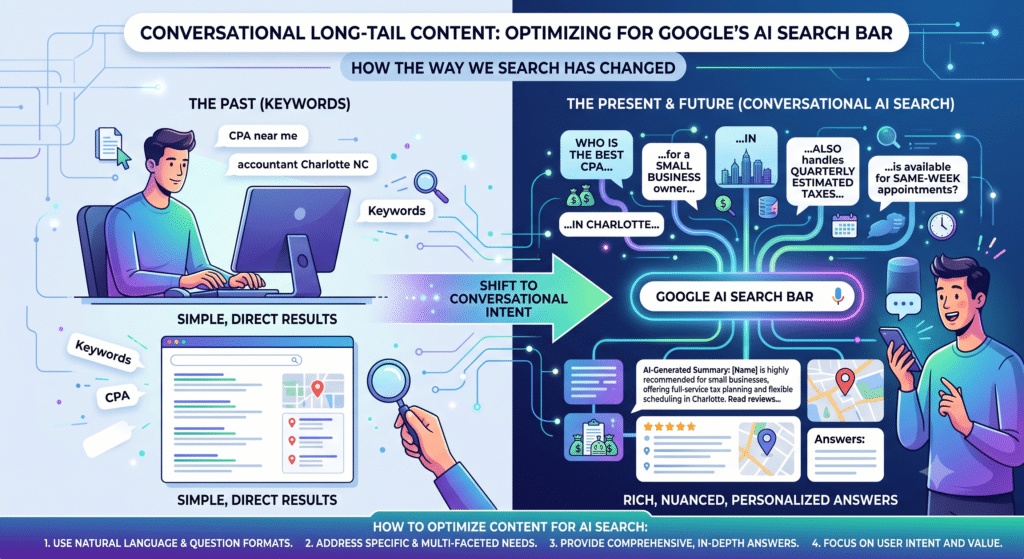
The way people search has changed. Two years ago, a user looking for a local accountant might type “CPA near me” or “accountant Charlotte NC.” Today, that same user might ask Google’s AI, “Who is the best CPA for a small business owner in Charlotte who also handles quarterly estimated taxes and is available for same-week appointments?”
That’s not a keyword — it’s a conversation. And Google’s AI is built to answer it by pulling from content that directly addresses exactly those specifics. If your website’s content is built around short, generic keywords and broad service descriptions, the AI doesn’t have what it needs to cite you. But if your content answers the specific, conversational questions your customers are actually asking, you become the source the AI quotes.
Why Conversational Search Changes Everything
Google’s AI Mode and AI Overviews are trained to understand natural language queries and synthesize responses from multiple authoritative sources. This means the ranking algorithm has shifted in meaningful ways:
- Specificity beats generality. Content that answers a narrow question precisely outperforms broad content on general topics.
- Conversational phrasing beats keyword density. Writing that sounds like a natural explanation of a topic performs better than content stuffed with exact-match keyword phrases.
- Question-answer structure is directly citable. The AI can extract a clean answer from a well-structured Q&A format and present it as its response — with your site as the source.
- Depth signals authority. Long-form content that comprehensively addresses a topic tells the AI that your site is an expert resource, which increases citation likelihood across multiple queries.
How to Find the Questions Your Customers Actually Ask
Mine Your Own Business for Questions
Start with the questions you and your team field every day. What do customers ask on sales calls? What comes through your contact form? What do your support tickets look like? What does your Google Business Profile Q&A section contain? These are real, unfiltered questions from your actual customer base — and they are exactly what AI search users are asking too.
Use Google’s Own Tools
The “People Also Ask” section in Google search results is a direct window into the conversational queries people are searching around your topic. Search for your core services and systematically capture every “People Also Ask” question you see — then build content that answers each one.
Google Autocomplete is equally valuable. Start typing a question related to your business and let Google complete it. Each suggestion is a real query that real people have searched. These are content opportunities waiting to be claimed.
Study Your Search Console Data
Google Search Console shows you the exact queries that are bringing users to your site today. Filter for queries that look like questions (containing words like “how,” “what,” “why,” “best,” “can I,” “do I need”) — these are your existing conversational traffic opportunities, and they tell you where to double down.
Research Competitor Content Gaps
Use tools like SEMrush, Ahrefs, or even a careful manual review of competitors’ content to identify questions they’re ranking for that you’re not. Each gap is a content opportunity. Build more thorough, more authoritative answers than what already exists, and the AI will prefer your content as a source.
How to Structure Conversational Content for AI Citation
Lead With the Answer
AI systems are designed to extract clear, direct answers. If your content buries the answer to a question in the third paragraph after a lengthy preamble, the AI may not cite you — it will find a source that leads with the answer. Structure your content so the direct answer appears within the first two sentences after the question heading, followed by supporting explanation.
Use Question-Based Headings
Instead of a heading like “Our Accounting Services,” write “What accounting services does a small business owner need?” Instead of “About Our Process,” write “How does our digital marketing process work?” Question-based headings directly match conversational search queries and are far more likely to be pulled as AI citations.
Create Dedicated FAQ Pages for Every Core Service
Every service page on your site should have an accompanying FAQ section — or better yet, a dedicated FAQ page that goes deep on the questions customers ask about that service. These pages, combined with FAQ schema markup, become highly citable AI sources for any conversational query related to your service.
Write at the Right Length
For conversational content aimed at AI citation, the ideal length depends on the complexity of the question. Simple questions deserve concise, direct answers (200–400 words). Complex questions that require explanation deserve comprehensive treatment (800–2,000+ words). The key is to match the depth of the answer to the complexity of the question — not to pad content for the sake of word count.
Use Clear, Jargon-Free Language
AI search users ask questions in plain language. Your answers should be written in the same register. This doesn’t mean dumbing down your expertise — it means translating your expertise into language that a smart person unfamiliar with your industry can understand and immediately apply.

Content Types That Perform Best for Conversational AI Search
- Comprehensive FAQ pages organized by topic or service
- “How to” guides that walk through processes step by step
- “What is” explainer posts that define industry concepts your customers ask about
- “Best” and “vs.” content that helps customers make decisions
- Local content that answers geographically specific questions (“Best [service] in [city]”)
- Problem-solution content that starts with the customer’s pain point
- “When should I…” content that addresses timing questions
Building a Content Calendar Around Conversational Queries
Treat conversational content creation as an ongoing discipline rather than a one-time project. Build a monthly content calendar that includes:
- Two to four new blog posts targeting specific conversational queries
- Monthly updates to existing FAQ pages adding new questions as they emerge
- Quarterly audits of Search Console data to identify new question-based queries to target
- Regular review of Google’s “People Also Ask” results for your core service terms
Consistency matters. The AI’s assessment of your site as an authoritative source builds over time as you accumulate high-quality, conversational content. A site with 50 thorough question-answer pieces is dramatically more likely to be cited than a site with five.
The Compounding Return on Conversational Content
Conversational content has a compounding return that traditional keyword-optimized content doesn’t. Each question you answer well builds your site’s overall authority on that topic. As that authority builds, the AI becomes more likely to cite your site for related questions — creating a virtuous cycle where your content investment generates increasing returns over time.
The businesses that begin building this content library now — systematically, from a foundation of real customer questions — are building assets that will compound in value for years as AI search continues to grow.
→ Read the full guide: The AI Search Playbook: 5 Strategies Every Local Business Needs Right Now
How Justified Media Can Help
Ready to dominate AI search? Justified Media can help you build the strategy, implement the technical foundations, and create the content that gets your business cited, ranked, and chosen. Get in Touch with us Today!