

Structured Data & Schema Markup: The Technical Foundation for AI Search Visibility
There is a version of your website that your customers see — the designed, visual experience you’ve carefully built. And there is a version that Google’s AI sees — raw HTML and data signals that it parses to understand what your business is, what you offer, and whether you’re a credible source worth citing.
Structured data and schema markup are the technical bridge between those two versions. When implemented correctly, schema markup gives Google’s AI explicit, machine-readable answers to the questions it’s trying to answer about your business. That directness translates directly into higher citation rates, richer search results, and more prominent placement in AI-generated recommendations.
Despite its importance, schema markup remains one of the most underleveraged technical SEO opportunities for small and mid-sized businesses. Most of your competitors don’t have it. That’s your opening.
What Is Schema Markup?
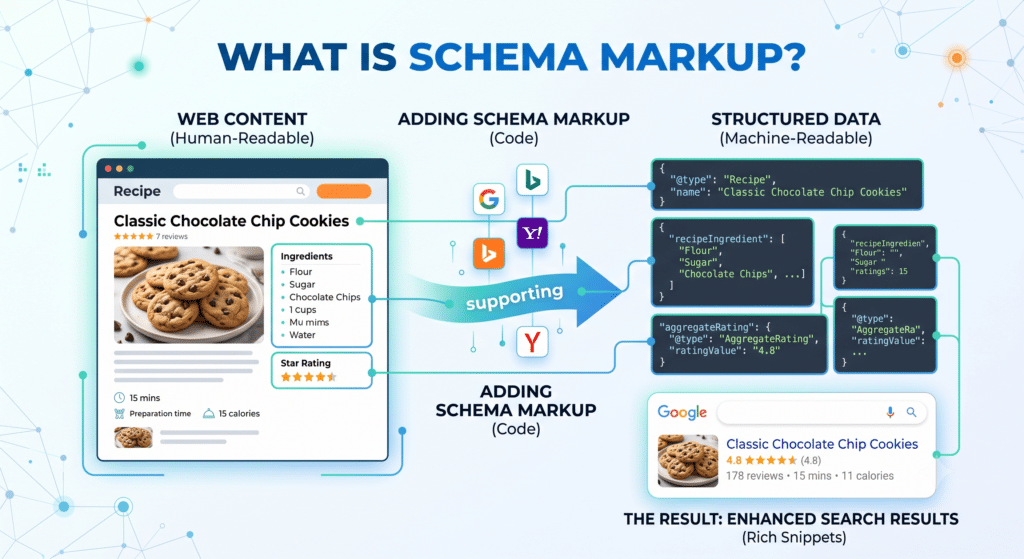
Schema markup is a standardized vocabulary of code — maintained at Schema.org and supported by Google, Bing, Yahoo, and Yandex — that you add to your website’s HTML to describe your content in a format machines can read unambiguously.
Think of it this way: without schema, Google reads your page and makes its best guess about what “John Smith” means — is that a person, an author, a business owner, a character in a story? With schema, you tell Google explicitly: this is a Person, their jobTitle is “Owner,” they works for this LocalBusiness. No guessing required. The AI gets a clean, reliable signal and can cite your information with confidence.
The Schema Types That Matter Most for Local Businesses
LocalBusiness Schema
This is the foundation. LocalBusiness schema tells Google everything it needs to know about your physical business: your name, address, phone number, website, hours of operation, price range, geographic coordinates, and the areas you serve. For businesses with multiple locations, each location gets its own schema block.
Key properties to include: name, address (with streetAddress, addressLocality, addressRegion, postalCode, addressCountry), telephone, openingHoursSpecification, geo (latitude and longitude), url, priceRange, and hasMap.
Service Schema
For service businesses, Service schema is the most important schema type after LocalBusiness. It allows you to describe each service you offer in structured detail — the service name, description, provider, area served, and pricing. When someone asks Google’s AI “Who offers [specific service] in [city]?” the AI draws from Service schema to match your business to that query.
AggregateRating Schema
AggregateRating schema surfaces your star rating directly in search results — the rich snippet that shows your average rating and number of reviews before a user even clicks your listing. More importantly for AI search, this schema tells Google’s AI that your business is reviewed, rated, and trusted. AI systems heavily weight social proof signals when constructing recommendations.
Important: your AggregateRating data must accurately reflect your actual reviews. Inflating ratings or counts violates Google’s guidelines and can result in manual penalties.
FAQ Schema
FAQ schema marks up question-and-answer content on your pages, making it directly available to AI systems as structured Q&A data. When Google’s AI is constructing an answer to a conversational query, FAQ schema from authoritative pages is one of its primary sources. Every FAQ page on your site should have this schema implemented.
Review Schema
Individual Review schema marks up specific customer testimonials and reviews on your site. Combined with AggregateRating schema, it gives the AI a detailed picture of your reputation — not just aggregate scores, but specific, attributable customer experiences.
BreadcrumbList Schema
BreadcrumbList schema helps Google understand your site’s structure and navigation hierarchy. This is particularly important for sites with multiple service pages or location pages — it helps the AI understand how your content is organized and navigate your site architecture.

How to Implement Schema Markup
Method 1: JSON-LD (Recommended)
JSON-LD (JavaScript Object Notation for Linked Data) is Google’s recommended method for implementing schema. It’s a block of structured data code placed in the <head> or <body> of your HTML — separate from your visible content, which makes it easy to add, maintain, and update without touching your design.
A basic LocalBusiness JSON-LD block looks like this: you define the @context as “https://schema.org”, the @type as “LocalBusiness” (or a more specific type like “DentalClinic” or “LegalService”), and then populate the relevant properties with your business data.
Method 2: Google Tag Manager
If you use Google Tag Manager, you can inject JSON-LD schema across your site without touching code. Create a Custom HTML tag with your schema code and fire it on the relevant page triggers. This is an excellent option for businesses that need to manage schema without developer access.
Method 3: CMS Plugins
If your site runs on WordPress, Yoast SEO, Rank Math, or Schema Pro all provide structured data management with varying levels of control. For Shopify, the platform includes some baseline schema — but custom schema additions require either app installations or code modifications.
Validating Your Schema
After implementing schema markup, always validate it using Google’s Rich Results Test (search.google.com/test/rich-results) and the Schema.org Validator. These tools will surface any errors, warnings, or missing recommended properties. Errors in your schema can prevent it from being processed — always test before considering the implementation complete.
Also check Google Search Console’s Enhancements section after implementation. Google will show you which pages have valid structured data and flag any issues it detects in the wild.
The Long-Term Strategic Value
Schema markup is not a quick win. It’s a technical foundation that compounds in value over time. As Google’s AI systems become increasingly sophisticated, the quality and completeness of your structured data will become an ever-more-important factor in determining which businesses get cited, recommended, and surfaced in high-value AI-generated results.
Businesses that build this foundation now — and maintain it as a standard part of their technical SEO practice — are positioning themselves for durable AI search visibility. The businesses that ignore it will find themselves increasingly dependent on the AI’s best guess about who they are and what they offer — which is never as good as telling it yourself.
→ Read the full guide: The AI Search Playbook: 5 Strategies Every Local Business Needs Right Now
How Justified Media Can Help
Ready to dominate AI search? Justified Media can help you build the strategy, implement the technical foundations, and create the content that gets your business cited, ranked, and chosen. Get in Touch with us Today!