

Content Marketing for Restoration Companies: Build Useful Search Content
By Justified Media · Reviewed October 28, 2026
Restoration content should help the right customer understand your services, evaluate your company, and take an appropriate next step. A large article inventory is not the objective. A useful website answers distinct questions with accurate information and connects them to the work your team actually performs.
For a restoration company, that usually means a combination of clear service pages, practical customer-decision guides, genuine project evidence, and information for commercial or referral audiences. Each has a different purpose. This guide shows how to plan that content without creating another collection of interchangeable pages.
Choose the audience before the topic
A homeowner facing property damage, a property manager evaluating vendors, and a restoration owner researching marketing are different readers. Their questions belong on different websites or in clearly separated resources.
If you operate a restoration company, your service content should address the people who may hire you. If you market to restoration owners—as Justified Media does—your content should address business growth and marketing decisions. Mixing those audiences can create impressions without relevant inquiries.
| Reader | Useful question | Appropriate destination |
|---|---|---|
| Property owner seeking help | Does this company provide the service I need in my area? | Relevant restoration service page |
| Customer evaluating a provider | What happens after I contact the company? | Process guide linked to the service page |
| Commercial property manager | What capabilities and communication can this provider support? | Commercial capability page with genuine evidence |
| Restoration business owner | How should I evaluate SEO, paid leads, or a marketing partner? | Restoration marketing resource |
Build around real services and buying decisions
Start with the work your business performs. Water damage, fire and smoke, mold-related work, contents, and reconstruction may need different explanations when they are genuinely part of your offering. Do not add a service merely to capture a keyword.
For each priority service, describe scope, coverage, contact options, and the process a customer can expect. Then identify the questions that deserve a supporting guide. Examples include what information to provide when contacting the company, how an inspection is scheduled, how project updates are communicated, or what a commercial client should ask before choosing a provider.
Separate technical field guidance from marketing explanations. Have appropriately qualified people review statements about restoration procedures, health risks, insurance, or legal requirements. Avoid universal drying timelines, coverage promises, or do-it-yourself instructions that exceed the purpose of the page.
Use project evidence without exposing customers
A useful project story explains a real situation, your scope, the decisions made, and the outcome you can demonstrate. You do not need to publish a customer’s name or precise address to explain the work. You do need appropriate permission for photos, quotes, and any identifying information.
An anonymous story still needs evidence. Keep internal records supporting the account, remove identifying details, and describe limitations. Do not turn an illustrative example into a claimed client result. When a photograph is unavailable or not approved, use a process diagram or checklist instead of inventing a project.
- Situation: Describe the actual customer need without private details.
- Scope: Explain what your company performed and what it did not perform.
- Decisions: Describe relevant constraints and how the team approached them.
- Outcome: State only what the records support.
- Next step: Link to the service relevant to a similar customer.
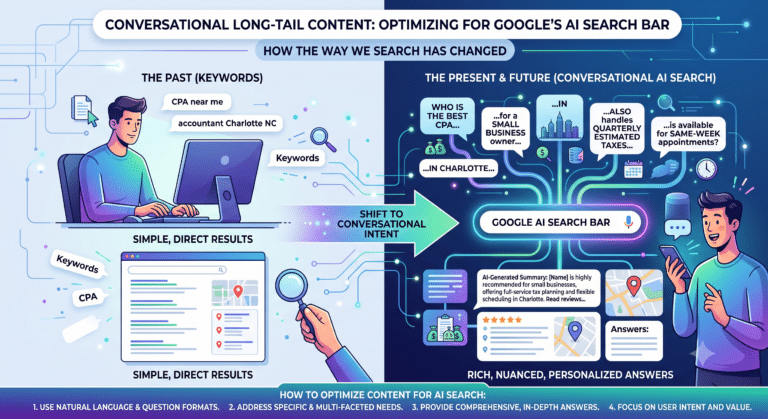
AI visibility uses the same sound SEO foundation
Google says there are no additional technical requirements or special optimizations for inclusion in AI Overviews or AI Mode. A supporting page must be indexed and eligible to appear with a snippet. Useful text, crawl access, internal discovery, page experience, and accurate structured data remain relevant. Read Google’s AI features guidance.
An FAQ section can help a reader when it answers genuine questions. It does not guarantee an AI citation. Adding a recent date does not establish expertise, and publishing a set number of articles does not establish authority. Update a page when its information changes or when you can make it more useful.
Use descriptive headings and direct answers because they improve comprehension. Show who is responsible for the content and accurately describe any relevant background. Never add certifications, years of experience, or reviewer credentials that you cannot verify.
Give every page a distinct job
Before publishing, compare the proposed topic with existing pages. If two articles answer the same question for the same reader, update the stronger existing resource rather than creating another near-duplicate. If a separate page is warranted, explain the difference in its brief.
A practical brief records the reader, primary question, service connection, source material, original evidence, content owner, and next action. It also names the existing page most likely to overlap. This makes content planning more disciplined than selecting a long list of keyword variations.
City pages deserve the same scrutiny. A new place name does not create a new answer. Publish local information when it meaningfully explains your presence, work, or service coverage. Otherwise, strengthen the relevant service and coverage information.
A six-piece starter plan for a restoration website
- Priority service page: Explain the work, coverage, process, and contact route.
- Customer process guide: Answer what happens from initial contact to the next confirmed step.
- Provider-selection checklist: Help customers ask useful questions without promising outcomes.
- Commercial capability resource: Explain actual service scope and communication for property managers, if this is a market you serve.
- Verified project story: Use approved evidence, with anonymity where needed.
- Repeated customer question: Answer one important question your team regularly receives.
This is a planning example, not a required publishing count. Start with the most important gap. One well-supported resource may be more valuable than several generic articles.
Measure content by relevant discovery and qualified inquiries
Use Search Console to check discovery, indexing, queries, and clicks. Review whether the queries reflect the audience you intended. A page attracting students, job seekers, or do-it-yourself researchers may not support the same objective as a service page.
Connect inquiry records to the content when the source is known. Distinguish page visits, contact-button clicks, submitted inquiries, and booked work. Do not report a contact-page view as a completed lead. Allow time for search discovery and the customer’s decision process before drawing conclusions.
When a page has relevant impressions but weak engagement, review the search intent and clarity of the answer. When several similar pages remain unindexed, investigate overlap and usefulness as well as technical settings. Publishing more copies rarely resolves that underlying problem.
Keep the publishing process manageable
Maintain a small queue with an owner and a review date. Check factual sources before publication, verify the live heading and canonical, confirm the page is accessible from relevant content, and inspect the mobile reading experience. Review older pages when platform rules or your services change.
For restoration marketing planning, continue with our restoration marketing guide, local SEO guide, and updated Local Services Ads guide.
Justified Media specializes in restoration marketing and also serves other service businesses. Explore our full-service restoration marketing approach or talk with our team about the gaps in your current website and content.
For a practical audit before planning more content, use our AI search visibility checklist for restoration companies. It includes service-information checks, repeatable prompt examples, and a worksheet for recording findings and choosing your first three fixes.