
RESTORATION OWNER WORKBOOK · NOVEMBER 3, 2026
AI Search Visibility Checklist for Restoration Companies
Find the gaps in how your restoration business is explained, discovered, and contacted. Leave with a short list of fixes—not another score you cannot act on.
This self-audit is for restoration owners and their marketing teams. Work through one priority service and a real market you serve. Mark each check Ready, Needs work, or Unknown, and keep a link or note supporting your answer.
Start the 16 checks · Run the observation exercise · Use the action worksheet
16 checks, with a practical next action
Business facts
01. Explain the work you actually perform
Check: Open your homepage and primary service pages. Can someone distinguish water mitigation, reconstruction, pack-outs, and any other services you actually offer?
Ready looks like: A visitor can identify the relevant service without guessing from broad disaster-recovery language.
If it needs work: Replace vague promises with your actual scope. Do not add services just because competitors list them.
□ Ready □ Needs work □ Unknown
02. Describe coverage and availability accurately
Check: Compare your website, contact page, and business profiles. Look for conflicting service areas, phone numbers, and hours.
Ready looks like: The information agrees and reflects how your team operates.
If it needs work: Correct the source you control. Explain meaningful coverage limits; do not imply a staffed office where none exists.
□ Ready □ Needs work □ Unknown
03. Make the business identity easy to verify
Check: Check the company name, About page, contact details, and links to legitimate business profiles.
Ready looks like: Readers can tell which company is responsible for the content and how to reach it.
If it needs work: Resolve outdated names and disconnected profiles. Only list affiliations or credentials you actually hold.
□ Ready □ Needs work □ Unknown
04. Answer the next customer question
Check: Read a priority service page as an owner or property manager seeking help. Look for the initial contact, assessment, and communication process.
Ready looks like: The page explains what happens next in clear language.
If it needs work: Ask the person who handles inquiries for the questions they hear repeatedly. Add accurate answers without making universal insurance or arrival-time promises.
□ Ready □ Needs work □ Unknown
Useful evidence
05. Replace generic claims with specific explanations
Check: Highlight phrases such as trusted experts or best service. Ask what a reader can inspect to evaluate each claim.
Ready looks like: Important claims have a concrete explanation or supporting evidence.
If it needs work: Describe your real process, relevant experience, or verifiable qualifications. Remove claims you cannot support.
□ Ready □ Needs work □ Unknown
06. Use project knowledge without exposing customers
Check: Choose an approved example and record the problem, work performed, and communication decisions.
Ready looks like: The example teaches something useful while protecting identifying details.
If it needs work: Obtain appropriate permission for material you publish. A process demonstration is a useful alternative when no project can be shared.
□ Ready □ Needs work □ Unknown
07. Give each page a distinct job
Check: Compare pages about the same service or place. Ask what useful answer each adds.
Ready looks like: Each retained page serves a clear need beyond a changed city name.
If it needs work: Combine genuinely overlapping material after checking links, search history, and advertising use. Preserve dedicated ad destinations.
□ Ready □ Needs work □ Unknown
08. Assign responsibility for accuracy
Check: Check whether someone familiar with the business reviews services, credentials, and technical statements.
Ready looks like: There is a real owner for factual corrections.
If it needs work: Have qualified people review field procedures or technical claims. Update information when the business changes, not simply to refresh a date.
□ Ready □ Needs work □ Unknown
Access and discovery
09. Check an important URL in Search Console
Check: Have your website manager inspect one priority service URL and distinguish the indexed result from the live test.
Ready looks like: The intended page can be discovered and its indexing status is understood.
If it needs work: Investigate unintended exclusions, a different selected canonical, or thin overlapping content. A successful live test does not confirm indexing.
□ Ready □ Needs work □ Unknown
10. Ask your developer to review crawler access
Check: Request a check of robots.txt, page directives, and hosting or CDN restrictions for the search systems you intend to support.
Ready looks like: Access choices are deliberate and the developer can explain them.
If it needs work: Fix unintended blocks. Review search access separately from model-training preferences; do not disable security protections indiscriminately.
□ Ready □ Needs work □ Unknown
11. Make important content readable and reachable
Check: Navigate from your homepage to the service page. Ask your developer whether its important text is available to search crawlers.
Ready looks like: Visitors can follow normal links to the page and read meaningful service information.
If it needs work: Repair orphaned pages, broken navigation, or content available only in an image. Use descriptive links rather than repeating keywords.
□ Ready □ Needs work □ Unknown
12. Keep structured information truthful
Check: Ask whoever manages markup to compare it with the visible page and current business facts.
Ready looks like: Any structured data describes the business and content accurately.
If it needs work: Correct errors and unsupported claims. Do not buy an AI-specific markup package on the assumption that it guarantees inclusion.
□ Ready □ Needs work □ Unknown
Observed visibility
13. Separate brand lookup from customer discovery
Check: Test one prompt containing your business name and another asking for the service and location without naming you.
Ready looks like: You record the two kinds of observations separately.
If it needs work: Do not treat an accurate answer about your name as proof that new customers will discover you.
□ Ready □ Needs work □ Unknown
14. Record the answer and inspect its sources
Check: For each test, record the exact prompt, platform, mode, date, stated location, answer, and linked sources.
Ready looks like: You can explain what was observed and check the supporting pages.
If it needs work: Distinguish a mention from a linked citation, a referral visit, and an inquiry. An answer may contain inaccurate facts even when it cites a source.
□ Ready □ Needs work □ Unknown
Business outcomes
15. Test the path from discovery to contact
Check: On a phone, open the service page and inspect the call and inquiry routes. Use a planned internal test for submissions rather than creating uncontrolled test leads.
Ready looks like: A relevant visitor can understand the offer and reach the right team.
If it needs work: Fix broken or confusing routes before buying more traffic. Make the next step and response process clear.
□ Ready □ Needs work □ Unknown
16. Measure inquiries separately from visits
Check: Ask what your analytics conversion actually records: a page view, a button click, a completed form, a connected call, or another action.
Ready looks like: The report labels each stage accurately and separates relevant inquiries from unrelated contacts.
If it needs work: Correct misleading definitions. Keep uncertain attribution marked unknown and compare observed visibility with actual business opportunities.
□ Ready □ Needs work □ Unknown
Observe AI answers without turning them into a fake ranking
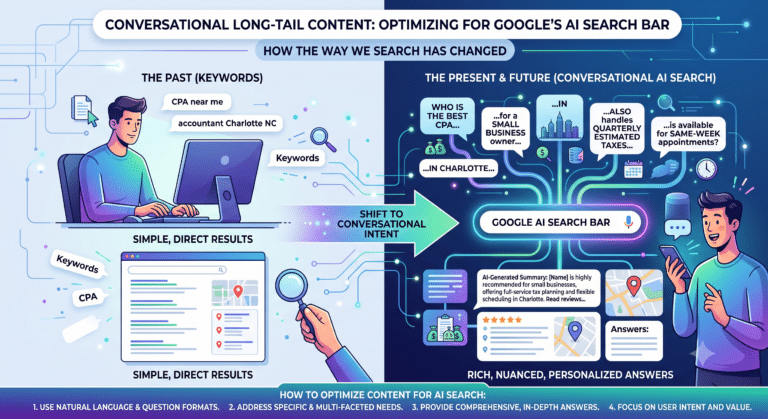
A single answer is a snapshot. Use a small, repeatable set of questions so you can compare observations without claiming to measure an entire market. The exercise below is a working method, not a validated visibility benchmark.
- Choose a scope: one real service, one area you serve, and the public page that should answer the question.
- Keep prompts stable: run the same questions in the same product and mode. Record whether web search was active and whether location or personalization was available.
- Start fresh conversations: avoid a prior discussion that has already supplied your business name or praised your company.
- Save the evidence: record mentions, citations, incorrect facts, and the exact source links. Open those links and inspect what they actually say.
- Repeat deliberately: choose a regular review date and repeat after material changes have had time to be discovered. Do not rerun until you get a favorable answer and report only that result.
Four prompt patterns
What services does [business name] provide in [area]? Link to sources for the service and coverage information.
Which companies provide [actual restoration service] in [area]? Include sources so I can check their services and coverage.
I manage a commercial property in [area]. Which providers describe [service you offer] and their process for working with property managers?
What should I check before choosing a [service] company in [area]? Include sources for the recommendations.
Replace bracketed text with public business information. Do not enter a customer’s address, claim details, or other private information. Skip commercial testing if that work is outside your offer.
How to interpret an observation
- Your business is absent: record it; this alone does not diagnose a technical fault or prove poor marketing.
- Your business is mentioned inaccurately: inspect the cited source, correct information you control, and document third-party corrections needed.
- A competitor is cited: inspect what the cited page answers. Identify a genuine information gap rather than copying the page.
- You are cited but receive no inquiries: review actual referral traffic, the landing page, contact path, and lead tracking. Citation counts alone do not establish business value.
- No web sources appear: label the result accordingly; do not compare it directly with a sourced search response.
A restoration-specific example
Illustrative scenario—not a client result: a company offers water mitigation and reconstruction, but its website says only “disaster experts.” Its commercial capabilities are described in a PDF that visitors struggle to find. An AI answer mentions the company for a different service.
The useful response is to check the cited source, make actual service scope explicit, publish a clear commercial-service explanation if that work is offered, and connect it through navigation. Record the changes and repeat the same observations later. Adding fifty city pages would not resolve the unclear service information.
What the platforms actually require
For Google’s AI Overviews and AI Mode, ordinary SEO foundations still apply. Supporting pages must be indexed and eligible for a search snippet. Google does not require a special AI text file or special schema for these features. Eligibility does not guarantee inclusion. Read Google’s guidance.
OpenAI distinguishes OAI-SearchBot, used for ChatGPT search, from GPTBot, associated with model training. Their controls are independent. Ask your developer to review the current crawler guidance and your intended settings rather than treating all AI access as one switch. Read OpenAI’s crawler documentation.
The remaining checklist items are practical editorial and business-review recommendations. They are not a list of disclosed AI ranking factors. For a deeper organic-search review, use our restoration local SEO guide.
Your working sheet
Print this page or copy these fields into your own document. Keep readiness checks separate from observed answers. Record evidence, not just a tick.
Business / reviewer: ____________________________________
Service / market: _______________________________________
Priority page / review date: ______________________________
Readiness record
Check number: ______ Status: Ready / Needs work / Unknown
Evidence URL or observation: __________________________________
Correction and person responsible: ______________________________
Target date and verification method: ______________________________
AI observation record — repeat for each prompt
Date / product / mode / search enabled: ___________________________
Stated location / personalization context: __________________________
Exact prompt: __________________________________________________
Business mentioned? ____ Linked citation? ____ Source URL: __________
Accurate facts / errors / answer saved at: __________________________
Next action / next review date: ___________________________________
Choose your first three actions
| Priority | Finding and evidence | Action / owner | Verify by |
|---|---|---|---|
| 1 | |||
| 2 | |||
| 3 |
Start with broken contact paths, materially wrong business information, and unintended access restrictions. Then improve thin service explanations and supporting evidence. Keep the observation log as a record of what changed—not a promise that the next answer will include you.
Turn the findings into a restoration marketing plan
Bring your priority service page and the three issues you found. We can discuss how your website, search presence, and inquiry path fit together. Justified Media specializes in restoration marketing and understands that owners need useful work and clear communication.
Discuss your restoration marketing · Explore our restoration services
For the broader channel plan, read our restoration marketing guide. For content planning rather than a visibility audit, use our restoration content guide.