
Why Local SEO Is the Most Valuable Long-Term Investment for Restoration Companies
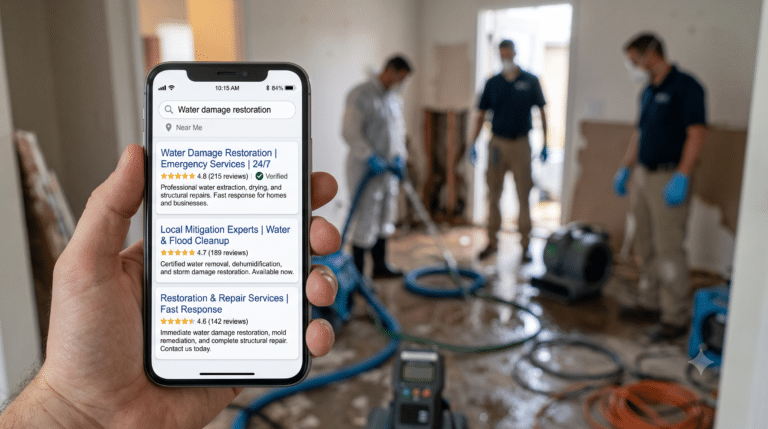
When a homeowner’s basement floods at midnight, they don’t call a friend for a recommendation. They pull out their phone and search. Over 90% of local service searches happen on Google — and the businesses that appear in the top three of Google’s local map pack capture the overwhelming majority of clicks, calls, and booked jobs.
Local SEO (Search Engine Optimization) is the practice of optimizing your online presence so that Google consistently ranks your restoration company for location-based searches in your service area. Unlike paid ads, which stop the moment you stop spending, local SEO builds compounding authority. A restoration company with strong local SEO rankings generates free, organic leads month after month — without paying per click.
This guide covers every component of a high-performance local SEO strategy for water damage restoration companies: Google Business Profile optimization, local citations, on-page SEO, link building, and the technical fundamentals that most companies overlook.
Understanding How Google Ranks Local Restoration Companies
Google uses three primary factors to determine local search rankings:
1. Relevance
Does your business match what the customer is searching for? Google evaluates your website content, your Google Business Profile categories and services, your reviews, and your overall digital footprint to determine how relevant you are to a given search.
2. Distance
How close is your business (or your stated service area) to the searcher? For restoration companies that serve multiple cities, this makes your service area configuration on GBP and your city-specific landing pages critically important.
3. Prominence
How well-known and trusted is your business? Prominence is built through reviews, citations, backlinks, website authority, and the overall quality signals Google can detect across the web. This is the factor that separates restoration companies who “sort of” show up in local results from those who dominate the map pack.
The most common mistake restoration companies make: They claim their Google Business Profile, fill in the basics, and assume the work is done. True local SEO dominance requires consistent effort across all three factors — and most competitors aren’t doing it.
Step 1: Claim and Fully Optimize Your Google Business Profile
Your Google Business Profile (GBP) is the single most important asset in your local SEO strategy. It’s the listing that appears in Google Maps, the local map pack, and Google Search — and it’s free to claim and manage.
Complete Every Section of Your GBP
Most restoration companies fill in the basics and leave it there. That’s a mistake. Google rewards completeness. Every section you fill in is an opportunity to be more relevant to a customer search.
- Business name: Use your legal business name — no keyword stuffing (this violates Google’s guidelines and can result in suspension)
- Primary category: Select ‘Water Damage Restoration Service’ as your primary category
- Additional categories: Add Fire Damage Restoration, Mold Remediation Service, and other relevant categories
- Service area: List every city, town, and ZIP code you serve — be comprehensive
- Business description: Write a 750-character description that naturally includes your primary keywords and services
- Services: Add every individual service you offer with descriptions
- Hours: Keep these accurate and up to date — include holiday hours and 24/7 availability if applicable
- Phone number: Use a local area code number, not a toll-free number

Photos and Visual Content
Google Business Profiles with photos receive 42% more requests for directions and 35% more website clicks. For restoration companies, photos are even more powerful — they show your equipment, your team, your work, and your professionalism before a single word is read.
- Upload a high-quality logo and cover photo immediately
- Add photos of your equipment (truck mounts, dehumidifiers, air movers, moisture meters)
- Post before/after photos from completed jobs (with customer permission)
- Add team photos — customers want to see the people coming into their home
- Upload photos of your vehicles, office, and certifications
- Aim for at least 25–50 photos to start; add new ones monthly
Google Business Profile Posts
GBP Posts are one of the most underutilized features in local SEO. You can publish updates, offers, events, and articles directly to your Google listing — and they appear prominently in your profile for up to seven days. Posting 1–2 times per week signals to Google that your business is active and engaged.
- Post seasonal content (‘Preparing your home for winter flooding season’)
- Highlight customer success stories and recent jobs
- Announce certifications, awards, or team additions
- Share tips and educational content that demonstrates expertise
Step 2: Build a Consistent Local Citation Profile
Local citations are online mentions of your business name, address, and phone number (NAP) across directories, websites, and platforms. Google uses citation consistency as a trust signal — when your NAP information is identical across dozens of authoritative directories, it confirms to Google that your business is legitimate and established.
Why Citation Consistency Matters
Inconsistent citations — different phone numbers on different sites, variations in your business name, outdated addresses — confuse Google and erode your local SEO authority. Before building new citations, audit your existing ones.
The Priority Citation Sources for Restoration Companies:
- Google Business Profile (foundational)
- Bing Places for Business
- Apple Maps / Apple Business Connect
- Yelp
- The Restoration Directory
- Angi (formerly Angie’s List)
- HomeAdvisor
- BBB (Better Business Bureau)
- Houzz
- Thumbtack
- Facebook Business Page
- Local Chamber of Commerce website
- State contractor licensing directories
- IICRC Certified Firm directory
- Restoration industry associations

Beyond these, look for city-specific directories, neighborhood platforms, and local news sites that accept business listings. The goal is to build a wide, consistent footprint that reinforces your local authority.
Managing Your Citations
Use a tool like BrightLocal, Whitespark, or Yext to audit and manage your citations at scale. These platforms identify inconsistencies, find new citation opportunities, and allow you to push updates across multiple directories simultaneously.
Step 3: Build Location-Specific Service Pages on Your Website
If your website has a single ‘Service Area’ page that lists ten cities, you’re leaving enormous ranking potential on the table. Google rewards specificity. A well-optimized location page for ‘Water Damage Restoration in [City Name]’ will consistently outperform a generic service area list.
What Every Location Page Needs
- A unique, keyword-optimized title tag and meta description (e.g., ‘Water Damage Restoration in Phoenix, AZ | [Company Name]’)
- An H1 that includes the city name and primary service
- At least 600–800 words of unique, locally relevant content
- Mention of local landmarks, neighborhoods, and community references to establish local relevance
- Embedded Google Map showing your service area
- Customer reviews or testimonials from that specific city when possible
- Clear calls to action with a local phone number
- Schema markup (LocalBusiness schema) properly configured

Building a City Page Strategy
Start with your primary service area — the city where you’re based and do the most work. Build a comprehensive, high-quality page there first. Then systematically create pages for each surrounding city in your service area, working outward by population and search volume. Use Google Search Console to identify which cities are already generating impressions for your site and prioritize those.
Insider tip: Don’t copy and paste the same content across city pages with only the city name swapped out. Google identifies this as duplicate content and may penalize your rankings. Each location page should have genuinely unique content that serves the customer in that specific area.
Step 4: Earn High-Quality Backlinks
Backlinks — links from other websites to yours — are one of Google’s most powerful ranking signals. In competitive restoration markets, the companies that rank at the top of organic search results almost always have more authoritative backlinks than their competitors.
The Best Link Building Strategies for Restoration Companies:
- Get listed in the IICRC Certified Firm directory (authoritative industry source)
- Join your local Chamber of Commerce and earn a link from their member directory
- Partner with local real estate agents and property managers who can link to you from their websites
- Sponsor local events, little leagues, or community organizations that have websites
- Reach out to local news outlets when you do notable work (large commercial jobs, disaster response)
- Write guest posts for home improvement, property management, or insurance industry blogs
- Get listed on supplier or vendor websites (equipment manufacturers, insurance company preferred contractor lists)

Quality matters more than quantity. One link from a respected local news site or industry association is worth more than 50 links from low-quality directories.
Step 5: Technical SEO Fundamentals
Even the best content won’t rank if Google can’t crawl, understand, and index your website properly. Technical SEO ensures that the foundation of your site is solid.
Core Technical SEO Requirements for Restoration Websites
- Mobile-first design: Over 70% of emergency searches happen on mobile. Your site must load fast and be easy to use on a smartphone.
- Page speed: Google’s Core Web Vitals measure loading speed, interactivity, and visual stability. Aim for a score above 75 on PageSpeed Insights.
- HTTPS: Your site must have an SSL certificate. This is a baseline requirement and a ranking factor.
- Clean URL structure: Use simple, keyword-rich URLs (e.g., /water-damage-restoration-phoenix/)
- XML sitemap: Submit a sitemap through Google Search Console so Google can efficiently discover all your pages
- Structured data: Implement LocalBusiness schema on your homepage and location pages to help Google understand your business
- Click-to-call on mobile: Make sure your phone number is clickable on every page of your mobile site
Step 6: Review Management as an SEO Signal
Reviews are explicitly mentioned by Google as a local ranking factor. The quantity, recency, diversity, and quality of your reviews all influence how prominently you appear in local search results.
This means your review generation strategy (covered in depth in our Reputation Management guide) directly feeds your local SEO performance. A restoration company with 150 recent reviews and a 4.8-star rating will almost always outrank a competitor with 20 reviews and a 4.2-star rating — all else being equal.
- Aim for a consistent cadence of new reviews (at least 5–10 per month)
- Ensure reviews mention your specific services and location for maximum relevance
- Respond to every review to demonstrate active engagement
Measuring Your Local SEO Performance
Local SEO is a long-term strategy, but you should still be tracking progress consistently. These are the key metrics to monitor:
- Google Business Profile insights: calls, direction requests, website clicks, photo views, and search queries
- Google Search Console: impressions, clicks, and ranking positions for your target keywords
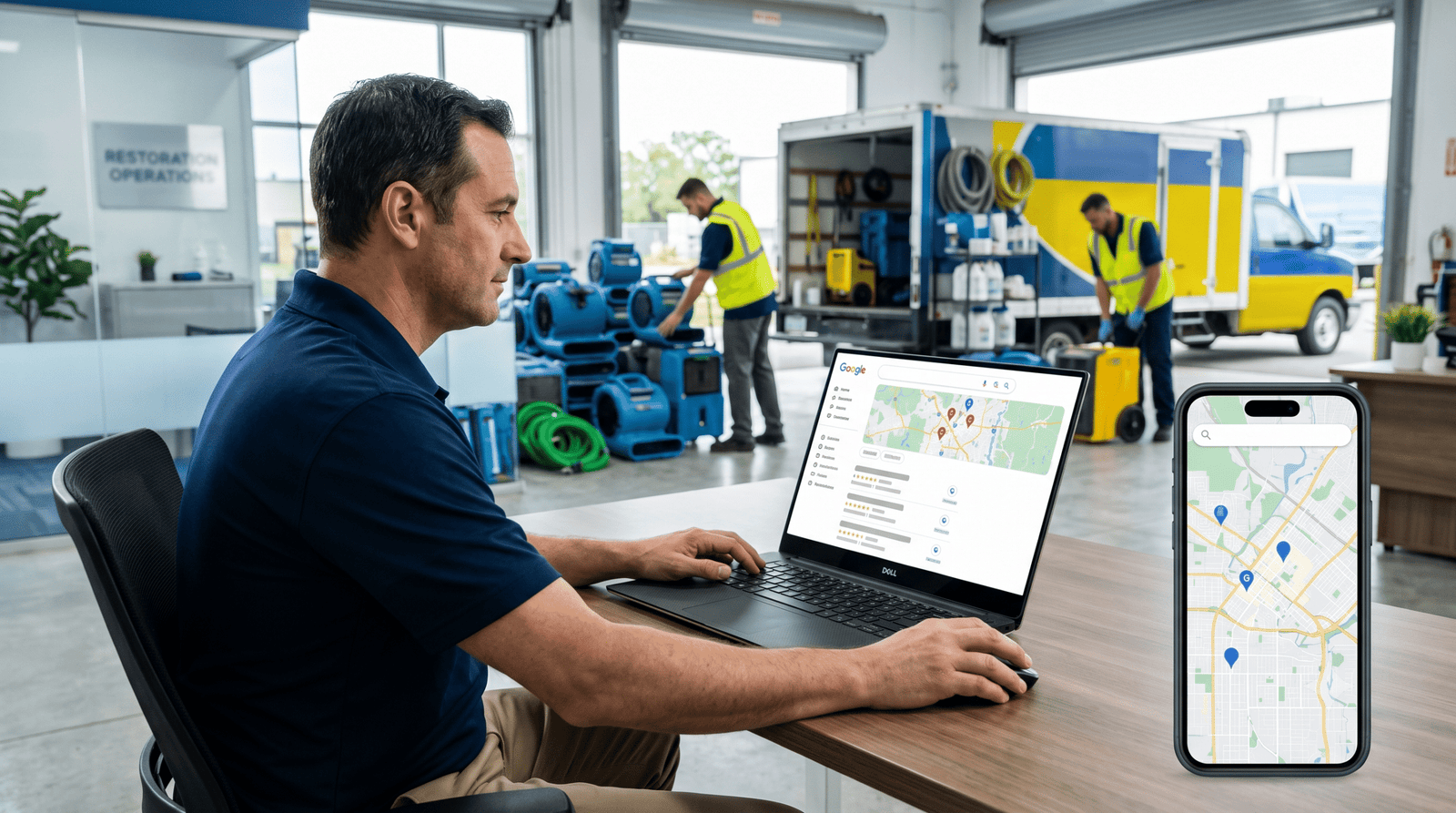
- Local map pack rankings: Use a tool like BrightLocal or Local Falcon to track where you rank in the map pack across your service area
- Organic traffic: Track month-over-month traffic growth to your location pages and service pages
- Lead volume from organic search: Connect your CRM or call tracking software to measure how many leads originate from organic search
Realistic expectations: Most restoration companies see measurable ranking improvements within 3–4 months of consistent local SEO work. Reaching the top 3 of the map pack in a competitive market typically takes 6–12 months. The work you put in today compounds into a durable competitive advantage that’s very difficult for competitors to replicate quickly.
How Justified Media Helps Restoration Companies Dominate Local Search
At Justified Media, local SEO for restoration companies isn’t a side service — it’s at the core of everything we do. Our founder came from the restoration industry and knows exactly what it takes to rank in competitive markets. We don’t offer cookie-cutter packages or recycled strategies. Every campaign starts with a deep analysis of your specific market, your competitors, and the gaps we can exploit.
Our local SEO services for restoration companies include Google Business Profile optimization, citation building and cleanup, location page development, link building, technical SEO audits, and ongoing performance reporting. We track every metric that matters and make adjustments based on real data — not guesswork.
Justified Media specializes in restoration company marketing. We know the industry, the customer, and what it takes to dominate your local market — because we’ve been there.